



We keep you up to date on the latest bankruptcy news here at Ruff & Cohen. Check out our stories to below to learn more about what is going on the financial world regarding bankruptcy filings and more. For answers to any questions you may have, turn to our Gainesville bankruptcy attorneys. You can reach us at (352) 376-3601.
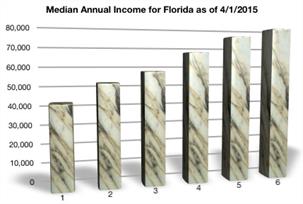
We just received some across-the board good news for Florida residents wishing to file Chapter 7. The U.S. Trustee's office recently new median income figures effective April 1, 2015. For residents of Florida, the news is all good news, because all the numbers have been raised.
The "median income" for various household sizes is a series of income benchmarks and is revised by the U.S. Trustee's office, usually twice a year. These numbers represent maximum annual income levels for households of different sizes that allows a debtor to file for Chapter 7 without raising a presumption of abuse and without requiring the debtor to pass the means test. What this means in practice is that if your annual household income is below the benchmark "median income" figure for your household size, then you are pretty much assured of qualifying to file Chapter 7 if that's what you wish to do. Conversely, if your annual household income is higher than these limits, you may be denied access to Chapter 7 unless you can qualify some other way, such as passing the means test, or because your debts are mostly from business endeavors.
Higher median income numbers are better because higher numbers make it easier to show your own income is less than the benchmark amount. It's like getting under the bar in the limbo beach dance, the higher the bar, the easier it is to get under. The new figures that just took effect are, in general, 1.62% higher than they were before the new figures took effect April 1, 2015. So this is good news, indeed. When new figures change (which happens about twice a year) usually some household sizes do better or worse than others. But not this time; everyone does better!
Here are the new numbers, compared to those for the prior time period:
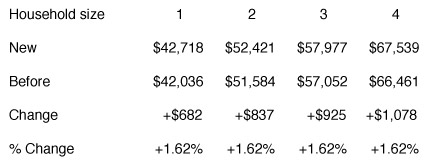
Note: for household sizes above 4, you add $8,1000 (for each additional member above 4) to $67,539. For example, for a Florida household of seven persons, the median income is now $67,539 + $8,100 + $8,100 + $8,100 = $91,839.
The next revision of these numbers will likely be announced somewhere around November 1, 2015.
The Judicial Conference of the United States has announced new filing bankruptcy fees effective June 1, 2014. Chapter 7 filing fees go up $29 from $306 to $335. Chapter 13 fees go up $29 from $281 to $310. Filing fees for Chapter 11 (not a common form of bankruptcy) go up $504 from $1,213 to $1,717.
The U.S. Trustee's office has announced the new median income figures for Florida residents considering filing for bankruptcy. These numbers, effective 4/1/2014, help determine qualifying for Chapter 7. The new figures will make it slightly easier for people to qualify for Chapter 7. For complete details and analysis, see this blog.

On July 2, 2013, Ruff & Cohen was advised the award from Laws.com was being made, in their words, "to honor your contribution to the society and your exceptional expertise in Bankruptcy Law." We certainly appreciate the recognition.
These and several other Bankruptcy Code dollar amounts directly and favorably affect debtors.
The U.S. Department of Justice has just announced new median income figures for residents of Florida. Fortunately, they are all going up, making it easier to qualify for Chapter 7. Any debtors who are "on the bubble" (a March Madness reference) of qualifying on the Chapter 7 median income test (and potential Chapter 13 debtors, who seek smaller monthly plan payments) might benefit by delaying the filing of their bankruptcy until April 1, 2013, to take advantage of the new numbers.
This increase reverses the trend established by the last revision on November 1, 2012. For a household of 1, it doesn't quite bring debtors back to the $42,053 median income from May 1, 2012. But for households of 2 and higher, these are better numbers than we have seen since November 1, 2010, over two years ago, when we experience significant drops from the March 15, 2010, levels.
It's both ironic and cruel when median income figures drop because it indicates not only that Floridians' incomes are dropping, but the side effect is that fewer people can qualify for Chapter 7. Let's hope the median income limits continue to rise.
The Bankruptcy Court system has just announced that other figures in the Bankruptcy Code are changing as well. These are also good news for debtors. The limits of debt for those who would like to file a Chapter 13 are being relaxed. The amount of allowable unsecured debt is being raised by $22,700 from $360,475 to $383,175. The amount of allowable secured debt is being raised $68,125 from $1,081,400 to $1,149,525.
Creditors get upset if a debtor borrows on Monday and files bankruptcy on Tuesday. Recent charges like Visa charges and cash advances in the days leading up to bankruptcy can give rise to a presumption of fraud by the debtor, the end result of which is that the debtor may not be forgiven such charges. The amount of charges that will give rise to the presumption is therefore an important number, the higher the better for the debtor. These numbers have been increased, as of April 1, 2013, as follows:
Regarding luxury goods or services charged to a single creditor in the 90 days before bankruptcy, the amount has been increased by $50 (a little over 8%) from $600 to $650.
Regarding cash advances from all creditors in the 70 days before bankruptcy, the amount has been increased by $50 (about 5.5%) from $875 to $925.
Exemption. Most debtors who file in Florida will use Florida state exemption laws to determine what property they are allowed to retain. However, debtors who have live in Florida for less that 2 continuous years may find that the federal list of exemptions applies to their case. The newest numbers from the bankruptcy court system indicate that the exemptions limits on the federal list going up across the board on April 1, 2013, another favorable change for debtors.
A ruling in favor of Chapter 13 debtors. The 9th Circuit Court of Appeals has joined the 5th Circuit (Florida is in the 11th Circuit) in ruling that Chapter 13 debtors need not contribute Social Security income to their Chapter 13 plan payments. In re Welsh, 2013 U.S. App. LEXIS 5880 (9th Cir. 2013). The courts are not in agreement on this issues and the U.S. Supreme Court could one day resolve the differences. In this particular case, the court went even further and said that Chapter 13 debtors could also count as continuing expenses the payments on their two ATVs and an Airstream trailer! Wow! Don't count on that treatment in Florida courts, though. The 9th Circuit wasn't saying it was a good idea, only that Congress passed a law saying that debtors should subtract payments on "secured debts" without limiting the debts to necessary type expenses and this court was following the letter of the law as they saw it.
Pity the credit card company's position in bankruptcy. Credit card companies generally fare poorly in bankruptcy cases. They are in the least protected class of creditors – general unsecured creditors. Credit card debts are not backed by "collateral" (compare a bank car loan where the bank can repo and sell the car - the collateral - to get some of their money back.) Nor do credit cards enjoy any other special bankruptcy status such as is enjoyed by "priority" debts like child support obligations or recent tax debts. If there is any money to be paid to any creditors, priority creditors must be paid in full before anything is paid to the lowly general unsecured creditors.
No love. As a result of their low classification, credit card companies have relatively few cards to play in bankruptcy, especially in the most common type of bankruptcy – Chapter 7. Often there is no money at all to be distributed to any creditor. The result is that credit card debts often get swept overboard in bankruptcy never to be seen again. Even if the chapter 7 trustee does collect some money, available funds are first paid to other higher priority players (including the trustee for gathering and disbursing the funds). General unsecured creditors are the last to be fed.
I will gladly pay you Tuesday for a hamburger today. One bankruptcy tactic for credit card companies is to look for bankruptcy cases where the debtor has charged up the credit card right up to the day the bankruptcy case is filed. You can imagine how angry a credit card company gets if the debtor charges his credit card on Monday and then files bankruptcy on Tuesday.
Foolish or fraud? The law recognizes there is a difference between (1) making foolish financial purchases that you later cannot repay and (2) deliberately running up a charge card fully intending NOT to repay it. The first is unwise, but the second is fraud. The law says that if you borrow money with the present intention to NOT pay it back – that's just stealing; it's fraud.
Proven fraud is nondischargable. So bankruptcy law provides that if a creditor can prove you defrauded that creditor, then bankruptcy will not forgive that particular debt. Put another way, a debtor cannot be discharged of his obligation to repay debts incurred through fraud. Such debts are, therefore, in bankruptcy lingo "nondischargable."
Burden of proving fraud on the creditor. So how does a credit card company go about proving a debtor is guilty of fraud and did not intend to repay when making the charges? One way is to weave a number of factors together that will convince the judge. Some factors include closeness in time between the charges and the filing of the bankruptcy, the kinds of items and services charges being more of a luxury than a necessity, the amount of the charges being high, the pattern of the debtor's history showing unusual charges.
Don't bother asking the debtor what was in his heart. The one thing that will be a waste of the creditor's time in court is asking the debtor on the witness stand "did you or did you not intend to pay these credit card charges when you incurred them?" Every debtor will respond the same way "Sir, I fully intended to repay these charges when I used your credit card."
The presumption test. It is well known how unhelpful debtor testimony is on the issue of intent, and so the law has developed some rules to assist the bankruptcy judges and the creditors in trying to figure out which charges are merely foolish and which are fraudulent.
The rules, or the test, is found in Section 523 of the bankruptcy code and states that if a credit card company can prove either:
…then the debt owed to that creditor is "presumed" to be fraudulent -- unless the debtor can explain himself. In that situation, the debtor cannot remain silent, or he loses. An acceptable explanation might run something like: "Without any warning, I was laid off a week before I filed bankruptcy when my company downsized – otherwise I would have paid the credit card." If there is an acceptable explanation, the presumption disappears, and the credit card is left to prove fraud by some other evidence.
A gambit rises from the grave. Very recently, this gambit of credit card companies trying to prove fraud is enjoying a comeback after many years of neglect. As a result debtors and their attorneys need to start focusing on this issue and planning to blunt the attack. How? Most importantly by timing the filing of the bankruptcy case more carefully.
Take a close look at the rules. Notice that we are talking about two different time periods before the bankruptcy filing; one is 90 days and the other is 70 days. Notice also that one deadline applies on a creditor-by-creditor basis and the other applies to all creditors as a group. The 90-day deadline applies to each creditor by himself and it involves more than $650 and it must be for luxury goods or services. The 70-day deadline applies to all creditors as a group, and it must be for more the $925 for total cash advances, not purchases. So a creditor might only be able to show $700 in cash advances, but if it can be proven there was another $300 cash advance to a different credit card company, the total of $1,000 cash advances would satisfy the $925 threshold. For the 70-day rule, one creditor can also point to what happened to other creditors.
Timing is everything. The easiest, simplest, safest way to improve the debtor's defenses against a credit card company attack on these grounds is to just stop making all charges on credit cards and take no cash advances for a period of 90 days before the bankruptcy is filed. Put another way, delay the filing of the bankruptcy case until the danger period has passed. If the debtor has "90 days of clean living" before he files bankruptcy, it becomes much more difficult for the credit card company to assert and prove fraud. Of course, it is not absolutely necessary to have zero charges or cash advances during the forbidden time periods, and one can also argue that some purchases were necessities and not luxuries, but if you can get 90 days of clean (credit card) living before you file, you can certainly avoid any claim of a presumption of fraud. Sometimes it's better to not have a fight than to win a fight
While you are thinking over your bankruptcy options and trying to decide what to do, it is important that you avoid some pitfalls that might make your situation worse.
Over the years we have seen potential clients make some mistakes that you can avoid. Here is a big one: